Why Do Some Texas School Districts Combine Armed Officers With Unarmed Security Staff on One Campus?
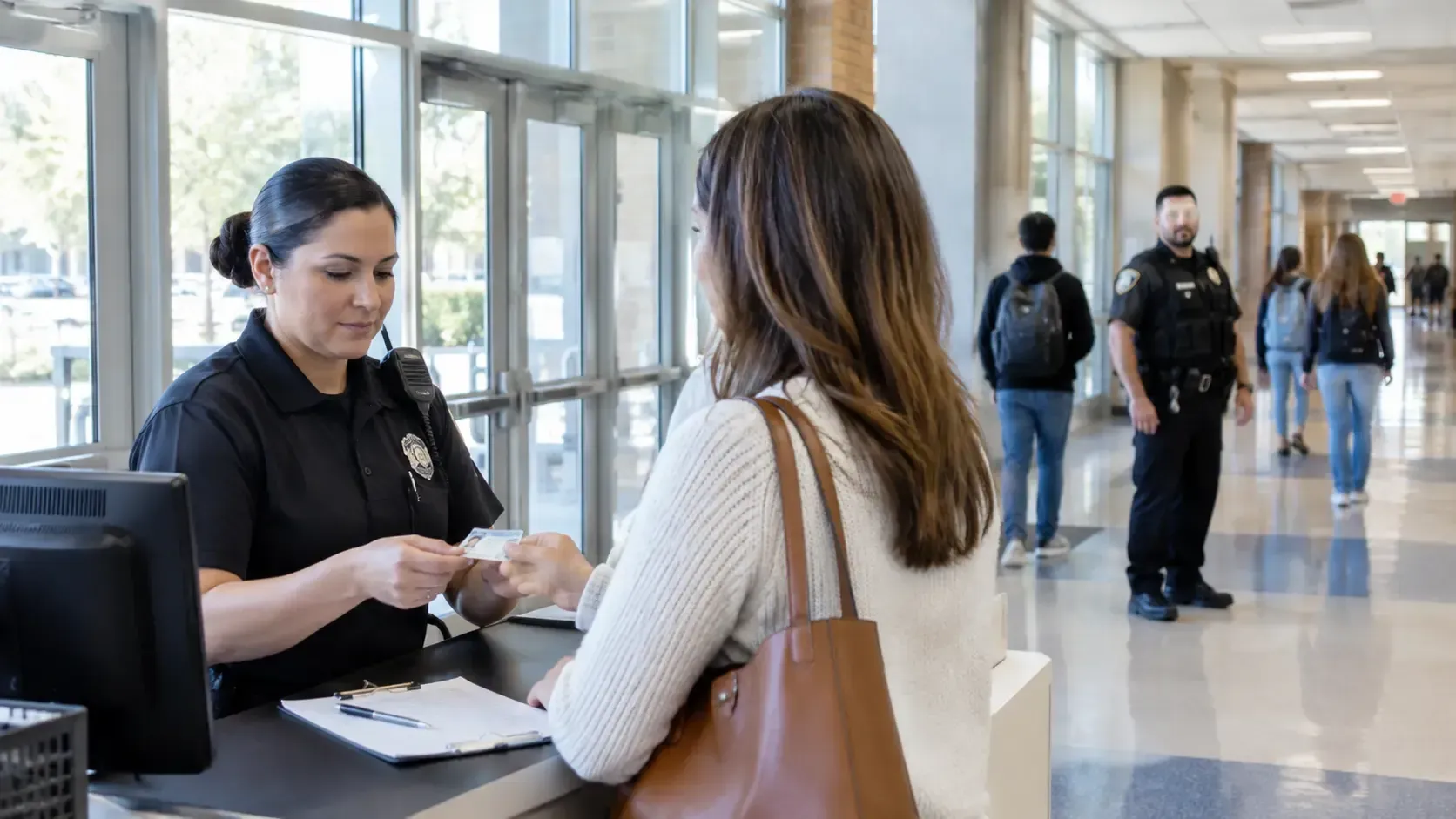
Table of Contents
- Introduction
- Why Districts Split Armed and Unarmed Roles
- What the Armed Officer Is Actually There For
- What Unarmed School Security Staff Handle
- How Layered School Security Changes Campus Coverage
- What Decides the Mix for a Given School
- Where a Mixed Model Goes Wrong
- Conclusion
- Design a Layered Campus Security Plan
- Frequently Asked Questions
Key Takeaways
- The armed officer stays available for rapid response rather than being tied up at a desk.
- Unarmed staff handle the high volume routine work: entry, visitors, hallways, dismissal.
- One officer cannot be at the front door and anywhere else at the same time.
- The right mix depends on campus size, layout, age range, and district policy.
- The model fails when roles are not written down and everyone assumes someone else has it.
Introduction
Districts combine armed and unarmed school security staff so the armed officer stays free to respond to a serious threat while unarmed staff handle visitor check in, hallway monitoring, and daily access control. Splitting the roles lets each person concentrate on what they were actually trained for.
The alternative, which many campuses default to, is one officer doing everything. That works until two things happen at once.
Why Districts Split Armed and Unarmed Roles
The reasoning is about availability more than about weapons.
Consider a single officer on a campus. They are at the front entrance screening visitors because that is where the controlled access point is. That is a reasonable post and it is also a fixed one. While they are there, they are not in the hallway, not in the parking lot at dismissal, and not able to move quickly to the far end of a building.
Now add a second, unarmed person to the entry point. The armed officer is freed from the desk. They can move, cover more of the campus, and be positioned to respond rather than positioned to process visitors.
That is the entire logic. The question districts are answering is not whether to arm people. It is how to avoid tying up their most capable responder in a role that does not require that capability.
What the Armed Officer Is Actually There For
The role is narrow by design, and keeping it narrow is the point.
What it covers:
- Rapid response to a serious threat, anywhere on the campus
- Mobility, staying unassigned to a fixed post where possible
- Coordination with law enforcement when an incident escalates
- Assessment of situations that have moved beyond routine
- Presence as a visible deterrent
What it should not cover, if the staffing allows: standing at a desk logging visitors, handling tardy slips, managing the parent pickup line, or any other task that fixes them in place for long periods.
Every routine duty assigned to the armed officer is a reduction in the thing they were hired to provide. Districts that understand this protect that person's availability the way they would protect any scarce resource.
What Unarmed School Security Staff Handle
This is the majority of the actual work on a campus, and it is where most of the daily
| Function | Why unarmed staff suit it |
|---|---|
| Visitor check in and logging | High volume, routine, relationship driven |
| Entry and exit monitoring | Fixed post, constant throughput |
| Hallway and common area presence | Requires familiarity more than force |
| Arrival and dismissal | Traffic, supervision, parent interaction |
| Event coverage | Crowd flow and access rather than threat |
| De-escalation of student conflict | Rapport matters more than authority |
| Deliveries and contractor access | Verification, documentation |
Most of what keeps a campus orderly is this work. It is also the work that benefits most from the same person doing it every day, because knowing which faces belong is the single most effective screening tool a school has.
We provide both, armed and unarmed, with the choice made around the school's needs and policies rather than around a standard package.
How Layered School Security Changes Campus Coverage
The practical gain is geographic. One person covers one place at a time.
A layered arrangement typically produces:
- A controlled entry point staffed continuously, without pulling anyone off patrol
- Interior presence during transitions, when hallways are busiest
- Exterior coverage at arrival and dismissal, which is when most campuses are least watched
- Someone free to move toward anything that develops
- Redundancy, so one person handling an incident does not leave the entry unstaffed
That last point is the quiet one. On a single officer campus, any incident anywhere means the front door is now unattended. Layering removes that trade.
It also changes response. Unarmed staff positioned through the building are the people most likely to notice something early and communicate it, which is worth more than any single response capability. Early notice is the whole game.
What Decides the Mix for a Given School
There is no standard ratio, and any provider offering one has not looked at your campus.
What drives the decision:
- Campus size and building layout, particularly multiple buildings or sprawling single story sites
- Number of entry points that have to be controlled
- Student age range, since elementary, middle, and high schools have different needs
- Enrollment and the resulting traffic volume
- District policy on armed personnel
- Event schedule, including athletics and evening use
- Local law enforcement response time to that specific address
- Budget, which is a real constraint and should be stated plainly
Response time deserves attention. A campus five minutes from a police station and one twenty minutes out have genuinely different needs, and that is a geographic fact rather than a sales argument.
Elementary campuses often weight toward relationship driven unarmed presence. Large high schools with multiple entrances and evening events generally need more of both. We work across public schools, private schools, charter schools, and college campuses, and the answer differs every time.
Where a Mixed Model Goes Wrong
Layering fails in predictable ways, and all of them are avoidable.
- Roles are not written down. Everyone assumes someone else is covering the thing nobody is covering.
- The armed officer gets absorbed into routine duties, which removes the reason for the arrangement.
- Communication is informal, so information does not move between posts quickly.
- Nobody has coordinated with the district's own staff, including administrators and counselors.
- Coverage gaps at transitions, such as shift changes or lunch, go unplanned.
- The plan is never practiced, so it exists on paper only.
The first and second are the common ones. A district builds a sensible layered plan, and within a month the armed officer is running the pickup line because they were standing nearby and someone needed help.
Write the roles down. Review them a few weeks in. The credential question is separate and covered in what Safe School certification actually requires, which is worth settling before anyone is posted.
Conclusion
Districts mix armed and unarmed staff for a practical reason rather than an ideological one: a single officer cannot both hold the entry point and be free to respond. Unarmed staff carry the high volume routine work that keeps a campus running, the armed officer stays mobile and available, and the campus gains coverage in more places at once. The right mix comes from your layout, age range, entry points, and local response times, not from a ratio. Write the roles down, protect the armed officer's availability, and review it after a month, because that is when the plan starts quietly drifting.
Design a Layered Campus Security Plan
If your district is working out the right staffing mix, we will look at your campus layout, entry points, and schedule, and recommend a plan built around them. Flash Point Security & Protective Services provides Safe School trained and certified guards, available armed or unarmed, for public schools, private schools, charter schools, and college campuses. We are a Texas licensed company, TXL# B31055001 and TXL# C18897201, HUBzone certified, with the office open 24/7. Call (806) 877-2615 or
start a plan with us.
Frequently Asked Questions
Why do schools use both armed and unarmed security staff?
So the armed officer stays free to respond anywhere on campus rather than being fixed at a desk. Unarmed staff handle visitor check in, hallway monitoring, and access control, which is the high volume routine work that keeps a campus running.
What do unarmed school security staff actually do?
Visitor check in and logging, entry and exit monitoring, hallway and common area presence, arrival and dismissal supervision, event coverage, de escalation of student conflict, and verifying deliveries and contractor access.
How many security staff does a school campus need?
There is no standard ratio. It depends on campus size and layout, how many entry points must be controlled, student age range, enrollment, district policy, event schedule, local law enforcement response time, and budget.
Should the armed officer handle the front desk?
Preferably not, where staffing allows. Every routine duty that fixes the armed officer in one place reduces the mobility and availability they were brought in to provide. Districts that understand this protect that role deliberately.
What makes a layered security plan fail?
Roles not being written down, the armed officer getting absorbed into routine duties, informal communication between posts, no coordination with district staff, unplanned gaps at shift changes, and a plan that is never practiced.